
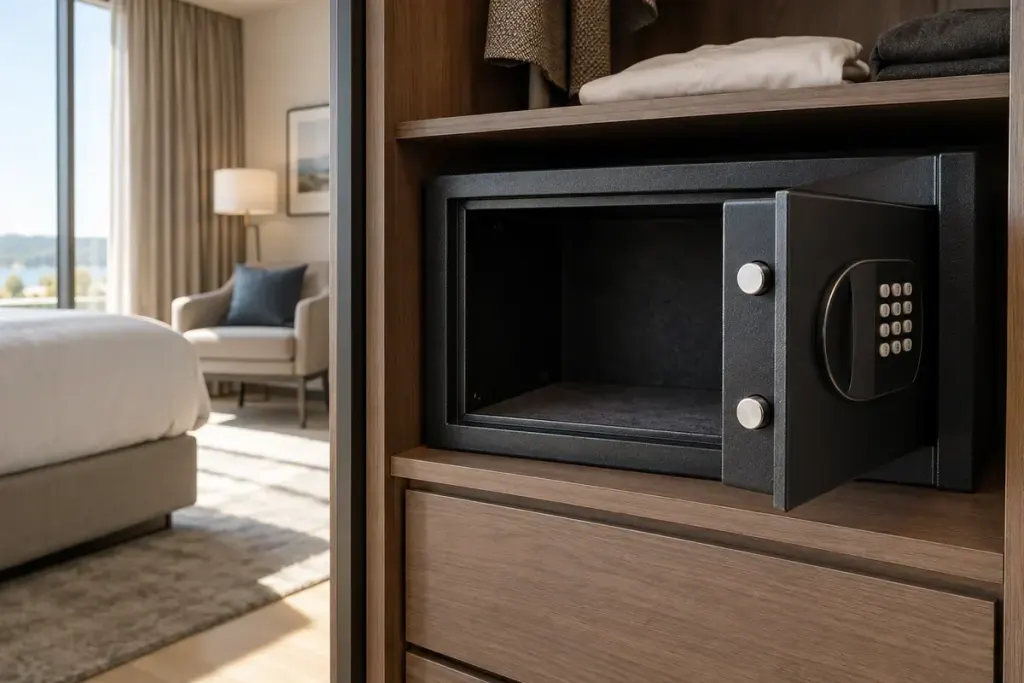
The room safe is easy to ignore until you are already leaving for dinner. Taking a minute to understand it while unpacking can prevent a confusing lockout later.
Read the instructions fitted to that particular safe. Controls differ, and a sequence remembered from another hotel may not apply. If the instructions permit testing the locking mechanism with the door open, do that first with the safe empty. Never force the door or bolts to make a test work.
Choose a code you can remember without using the room number or an obvious repeating pattern. Keep the code private. Before storing anything, check that the safe appears firmly installed and that the mechanism behaves as described. Report damage or unreliable operation to reception rather than experimenting with repairs.
Decide what belongs inside
An in-room safe offers a storage option, not an unlimited guarantee against loss. Ask the hotel about its valuables policy and any alternative secure storage if you carry something especially important. Insurance conditions and local rules may also affect your decision.
- Keep essential medication accessible in accordance with its storage requirements.
- Store travel documents so they remain easy to identify and retrieve.
- Avoid packing the safe so tightly that an item obstructs the door.
- Confirm the lock has engaged before walking away.
If you cannot reopen it, contact the hotel through an official channel. Be ready to show that you are the room’s registered guest. Do not follow an online bypass tutorial or allow an unverified stranger to work on it.
At checkout, use the same order every time: safe, drawers, wardrobe, bathroom and charging sockets. Open the safe fully and look inside rather than relying on memory. A discreet reminder in your packing list can be more reliable than leaving a valuable item beside the door as a cue.
Return the safe to the condition requested by the hotel once it is empty. A small, repeatable routine makes this part of travel less distracting.