
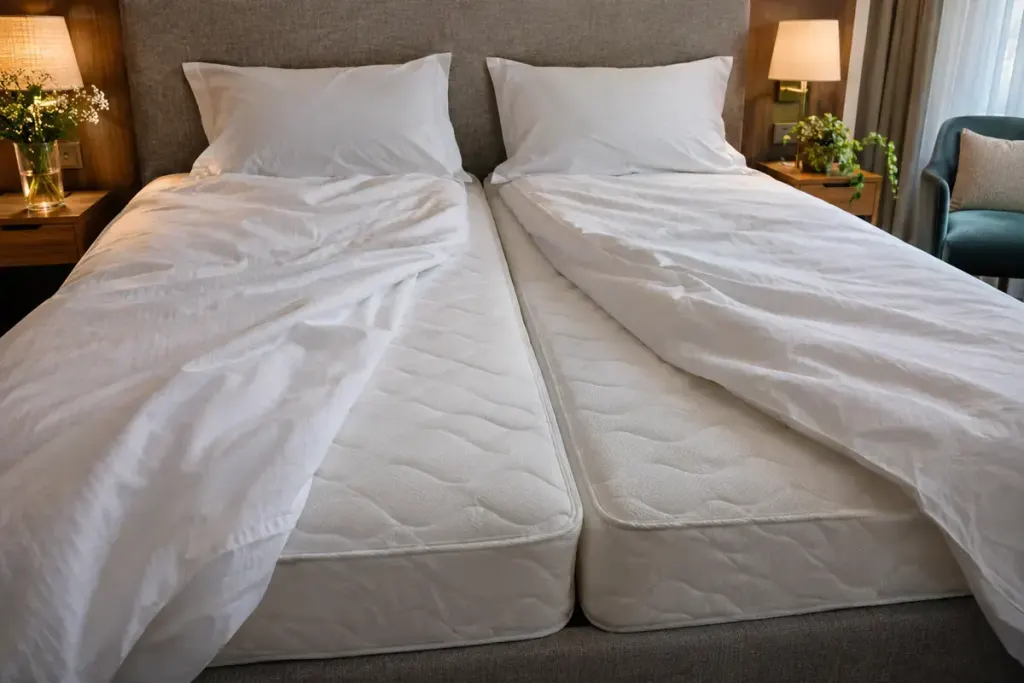
The room can be prepared as a twin or a double. That flexibility may come from a zip-and-link system: two mattresses and bed bases can be joined for one arrangement and separated for another. It is useful accommodation design, but the word “double” alone does not tell you what the middle of the bed will feel like.
Hypnos describes its zip-and-link construction as separate mattresses connected along their length, with linked divan bases. Hotels may use different systems and bedding, so ask about the actual room rather than assuming every convertible bed is identical.
Ask for the configuration you need
Put the request in practical terms: two separate beds with space between them, or one joined arrangement. Ask whether that setup is confirmed for the booked category and whether the hotel needs advance notice. A preference in a booking form is not always a guarantee.
If you are sensitive to a central join, ask whether a topper or another layer covers it and whether the hotel can describe the arrangement. A joined width does not make two mattress cores into one. Nor does a topper promise that every sleeper will find the join unnoticeable.
Check the whole sleeping arrangement
- What are the dimensions in the requested configuration?
- Will there be one duvet or separate duvets?
- Can both sides be reached comfortably?
- If separated, is there room for luggage without blocking the walking route?
For a family or an accessibility requirement, explain the specific need directly to the property. Do not infer a safe cot position, transfer space or extra sleeping place from the bed’s ability to split.
On arrival, check the room before unpacking fully. If the configuration differs from the confirmation, contact reception while there is time to resolve it. A short written description of the setup is more useful than debating whether the booking’s bed-size label was technically correct.