
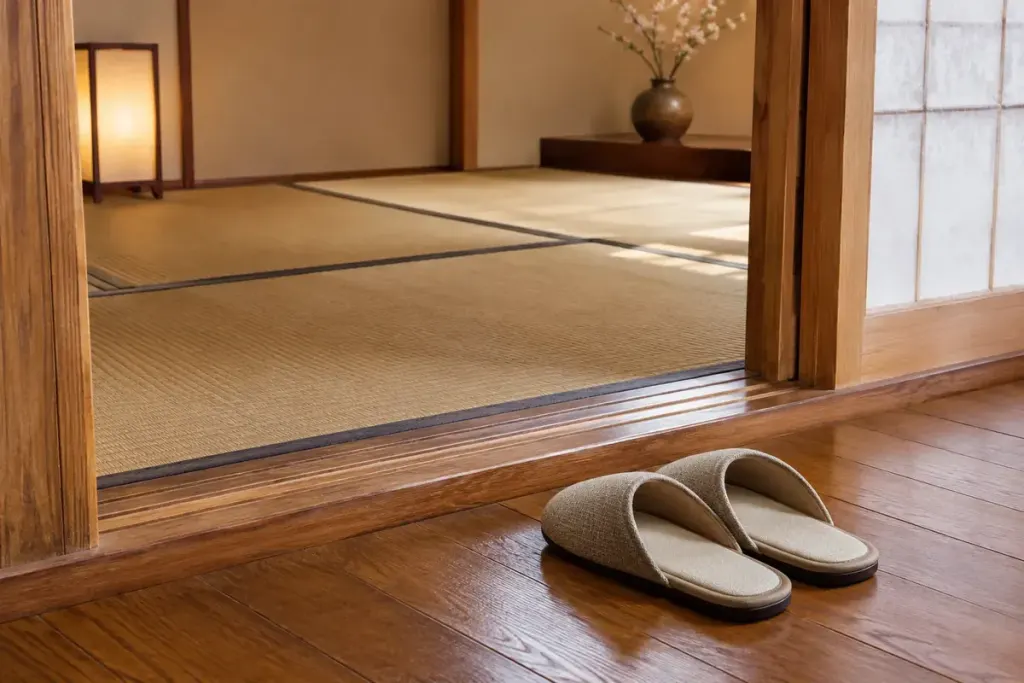
You have already removed your outdoor shoes, so it is tempting to assume the footwear question is finished. At a ryokan, another boundary may appear at the guestroom, a tatami corridor or the toilet.
The Japan Ryokan Association’s arrival guidance explains that some corridors are themselves tatami-covered, in which case shoes and slippers are left off. The material underfoot and the inn’s own arrangement matter more than a blanket rule that slippers belong everywhere indoors.
Look for the place where corridor slippers are meant to stay. Step onto tatami in socks or bare feet, following the host’s guidance. Avoid rolling a suitcase across the matting; the official Aichi travel guide’s ryokan etiquette also draws attention to protecting that surface.
A small arrival habit helps: set your bag down in an appropriate area, finish the footwear change, then move the bag as instructed. Trying to balance a suitcase, phone and shoes at the same time makes a simple boundary unnecessarily awkward.
Keep toilet slippers in their own area
Where a separate pair is provided for the toilet, use it only there and change back on leaving. Tono’s tourism association describes this distinction alongside the rule about keeping slippers off tatami. The exact layout varies, so ask if the placement is unclear.
If you realise you have carried the wrong pair into a corridor, return and change them. There is no need to turn a small mistake into an elaborate performance; a brief acknowledgement and correction are enough.
Travellers who need supportive footwear, orthoses or assistance at steps should discuss that before booking. Ask the inn about the route from reception to the room and what arrangements it can offer. A photograph of a beautiful entrance does not establish whether its change of level is manageable for you.
The goal is a comfortable stay that respects the room’s surfaces. Learn the particular inn’s boundaries on arrival, and the sequence soon becomes easier than trying to memorise every possible ryokan layout.