
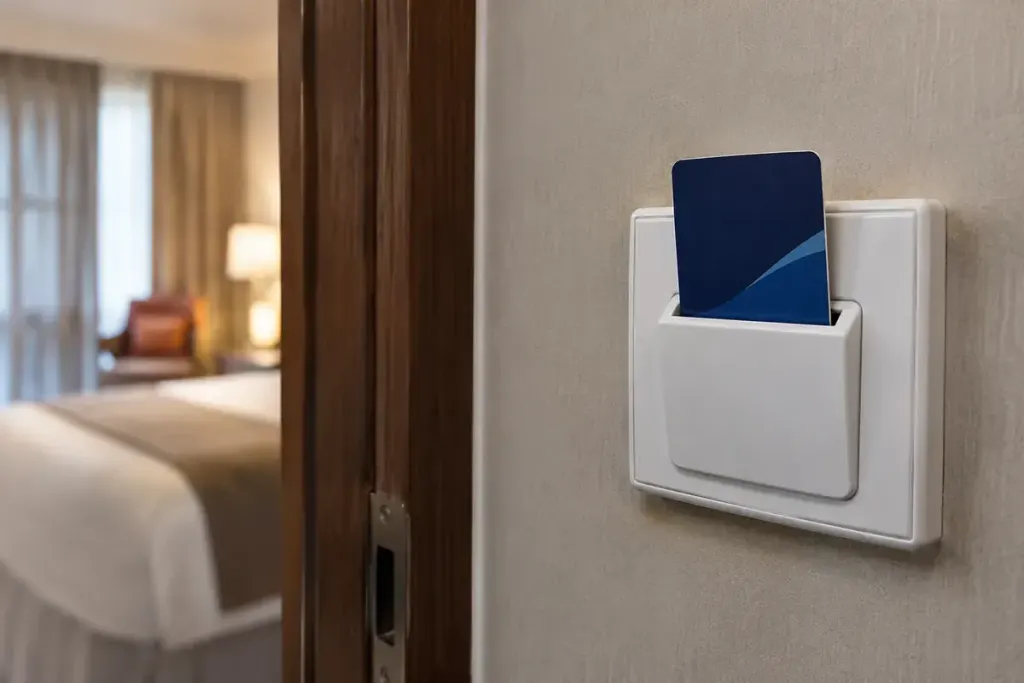
You leave a phone charging, take the room keycard from its wall slot and return to an unchanged battery level. The charger may be fine: the socket may have lost power when you left. A quick check on arrival can prevent that small surprise from disrupting the next morning.
The energy-efficiency guide for small and medium hotels hosted by UN CC:Learn describes keycard systems that switch room electricity when guests insert or remove a card. It also considers arrangements in which equipment such as a minibar remains powered. The actual circuits depend on the installation.
Ask about the socket you intend to use
Do not assume every outlet follows the same rule. Ask reception which sockets remain live when the card is removed, if any, and whether they are marked. A room’s lighting behaviour does not prove what happens at a particular bedside outlet.
If you need uninterrupted power for essential equipment, discuss that requirement directly with the hotel before relying on the room setup. Describe the need clearly and confirm a suitable arrangement rather than trying to defeat the switch with another card or object.
Make the charging plan part of unpacking
Identify the next device you will need: phone for tickets, camera for a morning trip, or another travel essential. Check the charger and socket while you are in the room. Leave enough time to charge during your stay if the available outlet is controlled.
For a shared room, agree where the keycard will be kept. One guest leaving with the only card can otherwise interrupt the other guest’s lighting or equipment. Reception can explain the hotel’s card arrangements.
A minibar is a separate question
Continuous electrical power does not establish that a minibar is suitable for storing food or temperature-sensitive medicine. Ask about the actual equipment and the hotel’s storage options if that matters to you.
Follow the room’s instructions and avoid modifying electrical fittings. If a switch, outlet or charger becomes hot, damaged or unreliable, stop using it and contact staff.
The useful habit is simple: learn what the room does before you depend on it. A short conversation at check-in can be more effective than discovering the wiring arrangement through an uncharged device.